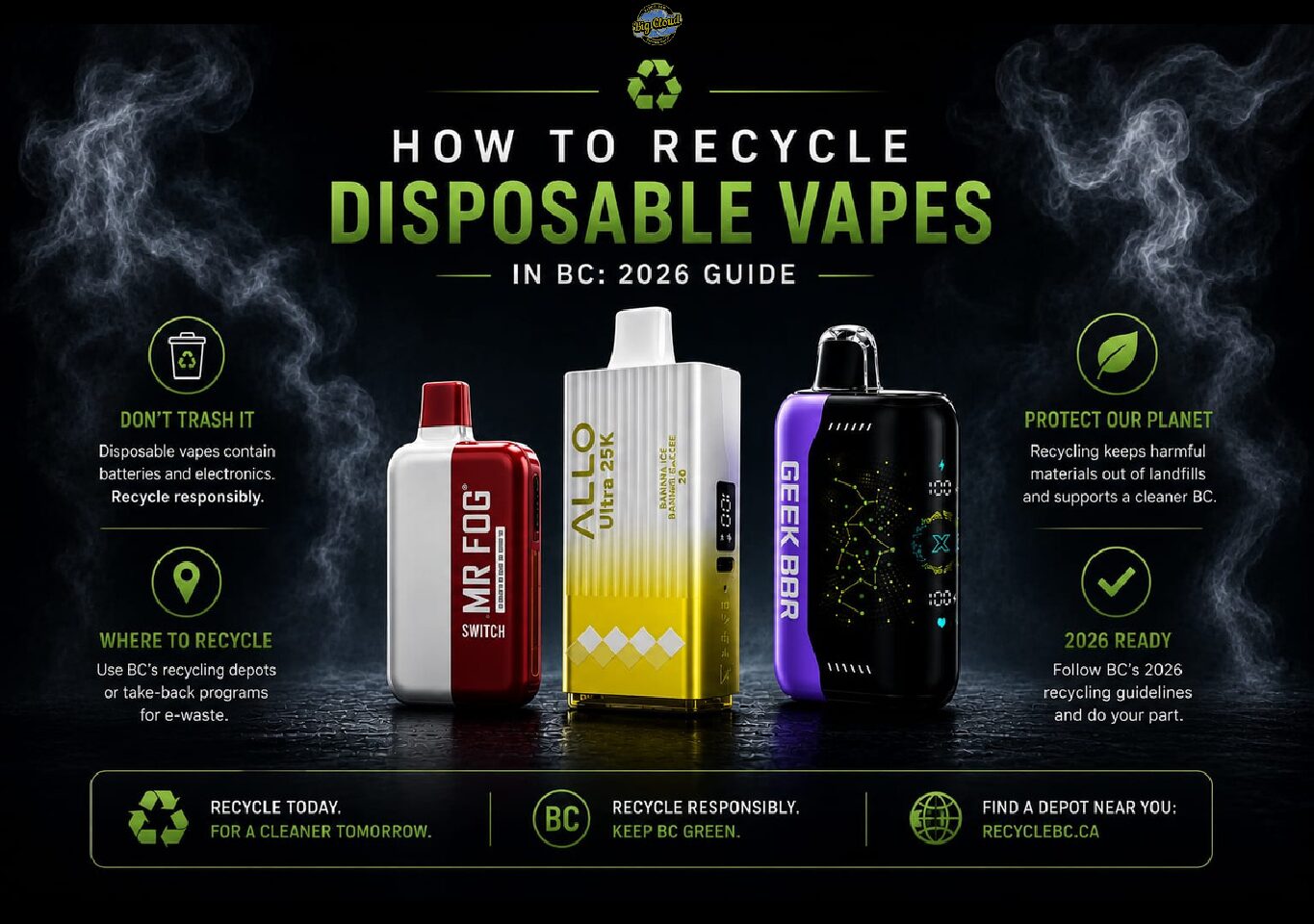
A used disposable belongs in an e-waste stream, not in your garbage, blue bin, or green bin. Take it to an electronics drop-off or a mail-back program in one piece, without pulling it apart. British Columbia added vapes to its recycling law in November 2025, but the province-wide collection program is not running yet.
Why a used disposable can’t go in your garbage or blue bin
The lithium cell inside a disposable still holds a charge long after the e-liquid runs dry. Empty is not dead. When a garbage truck’s hydraulic ram compacts a load, that cell can be crushed or punctured, and it releases its energy all at once into a truck packed with dry cardboard.
This is not hypothetical here. Batteries thrown in the garbage cause an average of three to four fires a year at each of Metro Vancouver’s six waste facilities, according to the region’s solid waste engineering staff, and those facilities have installed fire suppression systems to stop them spreading. Metro Vancouver environmental planner Andrew Doi described the problem as batteries turning up “in many places where we don’t necessarily anticipate batteries to be.”
The City of Vancouver’s instruction covers vapes by extension: batteries do not go in the garbage or in regular recycling. The blue bin is the worse option of the two, because a fire in a recycling truck destroys the whole load. For how these devices are built and why the cell is sealed in, see our complete guide to disposable vapes in Canada.
What BC law says right now (as of August 2026)
Vapes became a regulated product in British Columbia on 21 November 2025, when an amendment to the Recycling Regulation added “electronic cigarettes and vapes” to the battery-containing product category. That shifted end-of-life responsibility onto producers. It did not switch on a drop-off network, because the regulation gives producers a transition window.
| Date | What happens | What it means for you |
|---|---|---|
| 21 Nov 2025 | Vapes named in the battery-containing product category, BC Recycling Regulation, Schedule 3, s. 5(1)(a)(ix) | Producers are legally on the hook for collection |
| 15 Dec 2026 | Deadline for producers to submit a recycling plan to the province | Nothing visible in stores yet |
| Second half of 2027 | Call2Recycle’s stated expected launch for vape collection in BC | The first real drop-off network |
| 1 Oct 2027 | Deadline for producers to have an approved plan in force | Collection becomes a requirement, not a courtesy |
Regulatory details verified against the BC Recycling Regulation (B.C. Reg. 449/2004, as amended by B.C. Reg. 170/2025) in August 2026. We re-check this section quarterly, and the December 2026 milestone will change what’s on this page.
Two programs that will not take your disposable today
Nearly every guide to recycling vapes in Canada points readers at Recycle BC or a Call2Recycle battery bin. Both are wrong for a sealed disposable.
- Recycle BC handles residential packaging and paper. Your vape’s cardboard box, yes. The device, no.
- Call2Recycle’s BC programs cover household batteries under 5 kg and e-mobility batteries across more than 1,700 provincial drop-off points. Those bins are built for loose batteries you can lift out of a device. A disposable’s cell is sealed inside the shell, so it does not belong in one.
- Call2Recycle does run a vape program, Recycle Your Vapes, and it operates in Quebec, where producer-responsibility rules arrived earlier. It is the template for what BC gets in 2027, not something available here now.
Where to take a used disposable in BC today
Four routes work in the meantime, ranked by how reliably they take a whole device. Phone ahead on the middle two. Depot acceptance varies site by site, and a wasted trip is how people end up binning the thing anyway.
| Route | What it handles | How to check before you go |
|---|---|---|
| Mail-back through VapeCycle | Disposables specifically. Collect up to 20 used devices in a bag, submit the form, and a free courier label comes back by email | vapecycle.ca. Bags come from participating retailers; shipping is free |
| Electronics drop-off (Return-It Electronics depot, municipal transfer station, Vancouver’s Zero Waste Centre) | Small electronics. Vapes are not on published accepted-product lists, so acceptance is at the depot’s discretion | Call the depot and ask about a sealed vape, or use the City of Vancouver’s search-by-item waste tool |
| The RCBC hotline or Recyclepedia | Not a drop-off. It is the province’s own lookup for what goes where, by item and postal code | rcbc.ca/recyclepedia, the authoritative answer for your neighbourhood |
| A vape shop with a collection bin | Whatever that shop has agreed to take, usually disposables only | Phone first. See below for why this is voluntary |
One route does not exist: there is no deposit or refund scheme for vapes anywhere in Canada. You are not getting ten cents back.
How to prep a disposable before you drop it off
- Confirm it’s actually finished. A device can seem dead when the airway is blocked or a rechargeable cell has drained. Our guide on what to check before you write off a disposable covers the quick version.
- Do not take it apart. This is the step people get wrong, and at least one guide currently ranking above this one advises the opposite. Safety regulators are consistent: prying a sealed disposable open without proper equipment can make the cell spark and ignite, and the residual nicotine liquid is not something you want on your hands.
- Tape the terminals only if they’re exposed. That applies to a mod running a removable 18650, not to a sealed disposable. Clear or electrical tape over each end stops the cell shorting against keys and loose change.
- Store them cool and away from paper until you have a handful. A metal tin beats a bedside drawer. Never leave them in a hot car.
- Bag or box them for the trip so they can’t tumble loose against each other, then take them to the drop-off you confirmed.
If a device is swollen, cracked, or has been through the wash, isolate it in a non-flammable container and tell staff at the drop-off what they’re handling.
What happens to it after that
Collected vapes are not landfilled. In the Quebec program BC’s will be modelled on, collection partners inspect devices for damage, boxes with flame-retardant liners are couriered to a sorting facility, and processors weigh, sort, and break the units down into raw materials.
The recoverable content is worth chasing. A disposable carries lithium, copper, aluminum, and steel, and those metals go back into manufacturing rather than being mined again. The wick and residual e-liquid are the parts that can’t be recycled, and they’re handled as hazardous waste.
Can you just hand it back to a vape shop?
Sometimes, but no BC shop is obliged to take one. The duty in the Recycling Regulation sits with producers, and not until the 2026 and 2027 deadlines above. Any shop collecting used disposables in August 2026 is doing it voluntarily, usually by stocking VapeCycle bags, so the answer changes shop to shop.
Phone before you drive. Ask whether they take devices they didn’t sell you, and whether there’s a limit. Counter staff get this question regularly, so it’s a quick call.
If you’re replacing what you’re recycling, Big Cloud Vapor Bar stocks disposable vape kits at both the Burnaby and Vancouver stores, with hours and directions on our store locations page.
Frequently asked questions
Can you throw a disposable vape in the garbage in BC?
No. The sealed lithium cell can ignite when crushed in a collection truck, which is why batteries in Metro Vancouver garbage cause an average of three to four fires a year at each of the region’s six waste facilities. Your blue bin is no safer. Take the whole device to an e-waste drop-off or a mail-back program.
Can you get money back for recycling used vapes in Canada?
No. There is no deposit-return scheme for vapes anywhere in Canada, unlike beverage containers. Some retailers offer loyalty perks for bringing devices back, but that is a store promotion rather than a provincial refund, and no shop is required to run one.
Should I take the vape apart to remove the battery first?
No. Prying open a sealed disposable without proper equipment can cause the cell to spark or catch fire, and you risk contact with residual nicotine liquid. Drop-off points want the device intact. Only remove a battery from a device designed for it, such as a mod using a separate 18650 cell.
Does the device need to be empty before I recycle it?
Yes for mail-back programs, which ask that devices be fully used before bagging. At a depot it matters less, though a device with liquid left in it can leak in transit. Never pour leftover e-liquid down a drain. Leave it sealed inside the device.