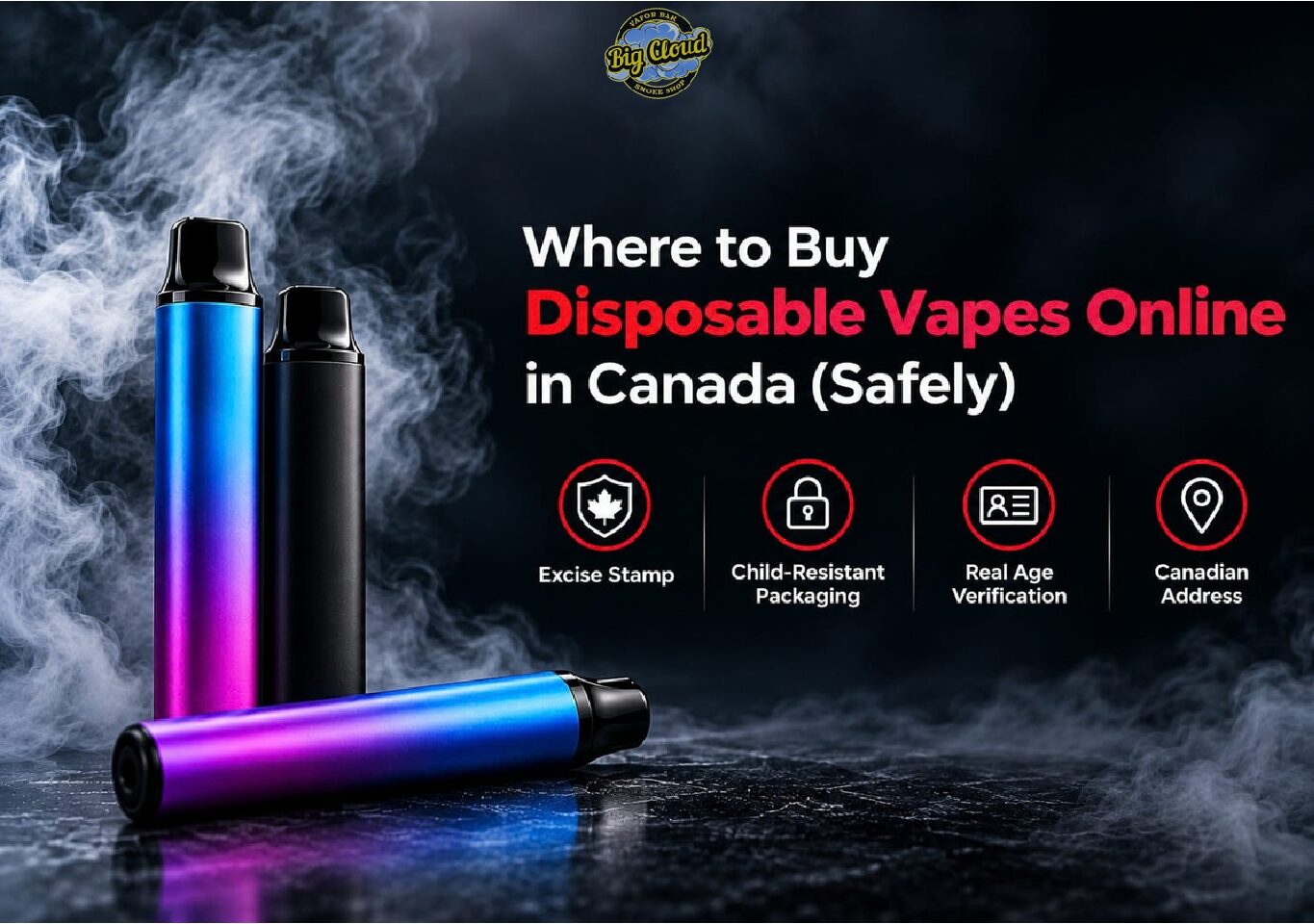
You can spot a genuine Canadian disposable vape retailer by four signs: every device carries an excise stamp, the packaging complies with child-resistant (CRC) standards, age verification is real rather than a simple click-through box, and there is a physical address in Canada that can be checked. A seller lacking any of these is operating outside Canadian regulations, and it is you who carries the risk, not them.
The Four Checks That Matter
1. The excise stamp
Every vaping product legally sold in Canada has been required since October 2022 to bear a federal excise stamp indicating that duty has been paid. In five provinces, namely Alberta, Manitoba, New Brunswick, Yukon and Prince Edward Island, an extra provincial stamp is needed in addition to the federal one. The stamp is required no matter what the nicotine content is, so both a device with 0 mg and one with 20 mg need it.
This is the easiest thing to check and the most difficult for a grey-market seller to imitate convincingly. If a device arrives without a stamp, it did not enter the Canadian market through legal channels.
2. CRC (child-resistant container) packaging
Under the Vaping Products Labelling and Packaging Regulations, which are enforced through the Canada Consumer Product Safety Act, all vaping products sold in Canada have had to meet child-resistant container standards since 1 January 2021. Disposables are included: closed-system devices are covered even though their sealed design already makes them relatively child-resistant.
The reasoning behind the rule is not abstract. A study published in Health Promotion and Chronic Disease Prevention in Canada found that 53% of vape-related hospitalisations between 2011 and 2019 involved children aged five and under. Legitimate packaging also carries a warning that the device stops being child-resistant once opened, and that it should be completely emptied before being thrown away.
3. Real age verification
A box asking you to confirm that you are of legal age is not age verification. True Canadian retailers verify a person’s age at some real stage of the process, for example by checking an ID at checkout, by scanning an ID upon delivery, or by carrying out a face-to-face check at the counter. Couriers are increasingly required to check ID on delivery for vaping products rather than leaving a package at the door.
The legal minimum age is also not the same everywhere. It is 19 in British Columbia and most provinces, 18 in Alberta, Manitoba and Quebec, and 21 in Prince Edward Island. A retailer shipping nationally has to account for all of them. Our full breakdown is in the legal vaping age guide.
4. A real, findable address
You can check the physical address of a genuine Canadian vape retailer: one with a real address you can look up, a phone number that answers to a person, and, if possible, a shop you can walk into. Big Cloud has one: 4927 Kingsway in Burnaby. The store is an age-restricted specialty vape retailer covered by BC’s E-Substances Regulation, a licensing category with its own compliance requirements, not a self-imposed label.
The profile of a seller who operates only on the internet and has no address that can be verified, no phone number, and no license at the provincial level should cause you to hesitate.
Red Flags of Grey-Market Sellers
These are the patterns worth treating as warnings:
- Nicotine strengths above 20 mg/mL. Canada’s federal cap is 20 mg/mL. A product advertised at 50 mg or “5%” is made for the US market and is not legal for Canadian retail sale.
- Prices well below the Canadian market. Excise duty is a real cost built into every legal device. A price that undercuts the market substantially usually means the duty was never paid.
- No age verification at any stage. Not at checkout, not on delivery, nowhere.
- Flavours that should not be available. Products marketed as candy, dessert, soft-drink or energy-drink flavoured are restricted from that kind of promotion under federal rules.
- No physical address, or a vague overseas one. Particularly when combined with payment methods that offer no recourse.
- Missing or suspicious packaging. Poor print quality, no excise stamp, no French labelling, no health warning.
Counterfeit products are a genuine and increasing issue, especially with respect to the most well-known brands. This is why our articles on Elf Bar and Maskking include sections devoted to authentication, since those two are among the most frequently faked.
Shipping Rules Differ by Province
Canada does not have a single national rulebook governing what can be sold where, which is why a retailer’s shipping policy can appear inconsistent from the outside.
Flavour restrictions apply in Quebec, Nova Scotia, Prince Edward Island and New Brunswick, where availability is limited largely to tobacco, mint and menthol profiles. Some national retailers simply do not ship to certain provinces as a result.
In British Columbia the rule is different once more, in that general retailers such as convenience stores are allowed to sell only e-substances with tobacco flavour, whereas retailers specialising in vaping and restricted by age may legally sell the full range of flavours. Our store belongs to that latter category. The full picture is in our BC vaping laws guide.
Age minimums vary as covered above, and provincial excise stamps are required in five jurisdictions. A retailer that ships nationally has to track all three sets of rules simultaneously:
| Province / Territory | Minimum age | Flavours restricted | Provincial excise stamp |
|---|---|---|---|
| British Columbia | 19 | No | No |
| Alberta | 18 | No | Yes |
| Saskatchewan | 19 | No | No |
| Manitoba | 18 | No | Yes |
| Ontario | 19 | No | No |
| Quebec | 18 | Yes | No |
| New Brunswick | 19 | Yes | Yes |
| Nova Scotia | 19 | Yes | No |
| Prince Edward Island | 21 | Yes | Yes |
| Newfoundland and Labrador | 19 | No | No |
| Yukon | 19 | No | Yes |
| Northwest Territories | 19 | No | No |
| Nunavut | 19 | No | No |
The Pickup Option
By buying online and then picking up the item personally, you eliminate most of the uncertainty all at once. You can see the device before you take it, the excise stamp and the packaging are right in front of you, age verification takes place face to face, and you don’t have to wait for a shipping period. In the event that anything is wrong, you can talk to the person who sold it to you instead of sending an email.
Pickup is available at our Burnaby store. For anyone in Metro Vancouver, this is the simplest way to buy with confidence.
What to Do Before You Order
A brief check before making a purchase will deal with the majority of the risk:
- Confirm the retailer has a genuine Canadian address and phone number.
- Verify that the nicotine concentrations listed on the website do not exceed 20 mg/mL.
- Look for any reference to excise stamps or Health Canada compliance.
- Check whether age verification is described anywhere beyond a checkbox.
If all four of these hold up, you are almost certainly dealing with a legitimate operation.
Ready to browse? Our full range is here: disposable vapes. If you are still deciding what to buy rather than where, start with the complete disposable vapes guide.
FAQs
Is it legal to buy disposable vapes online in Canada?
Yes, provided the retailer and the products comply with Canadian rules: 20 mg/mL maximum nicotine, excise stamps, CRC-compliant packaging, and genuine age verification. Provincial rules on flavours and minimum age apply on top of the federal ones.
How can I tell if a disposable vape is authentic?
Check for the federal excise stamp, proper French and English labelling, the Health Canada nicotine warning, and packaging quality. Many major brands also run online authentication systems using a code printed on the box.
Why do some Canadian vape sites refuse to ship to my province?
Because flavour restrictions in Quebec, Nova Scotia, PEI and New Brunswick limit what can legally be sold there, and some retailers choose not to maintain separate inventory rules for those provinces.
Do nicotine-free disposables need an excise stamp?
Yes. Canadian excise duty applies to vaping products regardless of nicotine content, calculated by liquid volume rather than nicotine concentration.
What does CRC mean on vape packaging?
Child-Resistant Container. Since January 2021, vaping products sold in Canada must meet child-resistant packaging standards under the Vaping Products Labelling and Packaging Regulations. The device stops being child-resistant once opened.