A disposable vape is a sealed and pre-filled device which heats the nicotine e-liquid into vapour when you take a draw from it and is recycled when the e-liquid is used up; there is nothing needed for refilling and no coil to replace. In Canada all legal disposable vapes have a nicotine content limit of 20 mg/mL.
The guide explains how they function, what is contained in them, how long they last, what the Canadian rules really state, and how to choose one; for those who want to find out more about any of these topics, there is a more detailed guide available for each section.
How Disposable Vapes Work
As you pull on the mouthpiece, the decrease in air pressure activates a small sensor located in the device. This sensor then causes the battery to supply power to a heating coil, which is either wound around or pressed against a wick that has been soaked in e-liquid. The coil heats the liquid until it turns into vapour, and the airflow that you’re producing carries the vapour up through the mouthpiece. When you stop pulling, the sensor switches off the power.
There is neither any provision of buttons, no settings to adjust, and nothing that needs putting together. This simplicity is actually the main reason for its appeal and it is also the reason why disposable vapes show such consistency from one brand to another since all of them carry out the same four functions. For more details, see our guide on how disposable vapes work.
What’s Inside: Battery, Coil, E-Liquid, and Airflow
The battery
The device is powered by a small lithium-ion cell. In the case of smaller disposable units, the cell has a duration similar to that of the e-liquid, meaning both of them expire at the same time. With larger devices, the battery can be recharged using a USB-C port since no battery could practically last for tens of thousands of puffs on a single charge.
The coil
The heating element is made up of a coil. In older disposables the heating element consisted of a strand of resistive wire which had been wound into a spiral; most current devices on the other hand use a mesh coil, which is a flat metal sheet with holes in it. The flat sheet is able to come into contact with a greater amount of e-liquid at the same time, resulting in more even heating and a more consistent flavour as the wick dries out later on in the device’s life. In devices with a high e-liquid capacity dual mesh is often used, that is to say two layers, for the same reason. Information on our mesh coils and on the e-liquid capacity is provided in the guide.
The e-liquid
E-liquid is made up of propylene glycol and vegetable glycerin with flavouring and nicotine being added. The capacity differs very greatly among devices, ranging from about 2 mL in the smallest to more than 20 mL in the largest. Buyers often fail to realise how important this capacity is, since the number of puffs and the volume of e-liquid do not consistently scale with each other. In the various devices we carry, the amount of liquid per 1,000 rated puffs varies from about 0.38 mL to 1.00 mL.
The airflow
The air goes in through small openings on the base or the sides, flows over the coil, and then takes the vapour to the mouthpiece. These openings also supply air to the pressure sensor, which is the reason why a clogged intake is one of the most frequent causes of a disposable stopping working. On some bigger devices you can adjust the airflow to make the draw tighter or looser.
Disposable vs Refillable Vapes
The term “disposable” refers to the way in which the device is used, not how long it lasts. A disposable that offers 50,000 puffs can last the coil in a refillable pod system several times longer. The actual difference lies in what you have to replace when it runs out.
| Disposable vape | Refillable pod or vape pen | |
| E-liquid | Sealed, pre-filled | Refilled from a bottle, or prefilled pods swapped |
| Coil | Built in, not replaceable | Replaced periodically |
| Setup | None; draw-activated | Some assembly and maintenance |
| Upfront cost | Lower | Higher, for the device |
| End of life | Whole device recycled | Only pods or coils replaced |
People who don’t want any maintenance and no need to learn how to use something would prefer disposables, while those who use it regularly would rather buy e-liquid or pods than purchase complete devices. Some companies make the distinction unclear: for instance, Vuse offers both a disposable product and a rechargeable one which uses prefilled pods.
Puff Counts and How Long a Disposable Lasts
All disposable vapes come with a rated puff count, this ranging from under 1,000 to over 50,000. These numbers are obtained under controlled laboratory conditions by means of short and even puffs, and in real-life situations the number is generally 30 to 40 per cent lower. The use of longer puffs, higher power settings, and frequent use all cause the total number of puffs to decrease.
View the rating as a means of comparison not as a guarantee. A device with a rating of 20,000 puffs will usually last longer than one rated at 10,000, but neither will reach the stated figure exactly for the average user. In terms of time, a moderate user could obtain a few days’ use from a small disposable and several weeks from a high-capacity one. For the calculations involved, see our guide on how long a disposable vape lasts, and for the signs that one is finished, see telling when a disposable is empty.
Nicotine Strength and Canada’s 20 mg/mL Cap
Under the federal regulations established by the Tobacco and Vaping Products Act, Canada has set the nicotine concentration in vaping products at 20 mg/mL. Prior to this limit being introduced, certain products available in Canada contained 66 mg/mL, which is more than three times the present limit. Products that are advertised as having 50 mg or as ‘5%’ are intended for sale in a foreign market and are not permitted to be sold retail in Canada.
The majority of disposables contain nicotine salt rather than freebase nicotine, and at higher concentrations nicotine salt is smoother, which is the reason why a 20 mg/mL disposable gives a gentler sensation than the same strength in freebase form. A few brands combine the two so as to achieve a stronger throat hit without going over the limit; in this case, when ‘Intense’ appears on the packaging it usually indicates the 20 mg/mL level rather than a distinct strength. For an explanation of what the figures mean, see our nicotine strength explainer, and information on nicotine-free choices can be found in our guide to 0 mg disposables.
Rechargeable vs Non-Rechargeable Disposables
The most useful thing to check on any disposable is the USB-C port, since it alters the meaning of almost every other signal. Check the base and the sides for a USB-C port.
If there is no port, the battery will deplete at about the same time as the e-liquid; the device is then considered finished when it ceases to produce vapour. However, if there is a port, the battery and the e-liquid are depleted separately, which means that a device that has stopped working might only need between 20 and 40 minutes charging. Many people do throw away rechargeable disposables even though there is still a day’s worth of e-liquid left in them.
Rechargeable products are the ones that take up the high-capacity side of the market, since a 20,000-puff device would otherwise be impractical. It is better to use a standard low-output charger rather than a fast-charging phone adapter; the small cells in these devices get hot when using a high amperage without charging any faster. For more details on charging rechargeable disposables, see our guide.
Are Disposable Vapes Legal in Canada?
So long as the products conform to Canadian regulations, adults may use them. All legally sold disposable products must have a federal excise stamp indicating that duty has been paid, a rule that has been in effect since October 2022. In addition, five provinces and territories—Alberta, Manitoba, New Brunswick, Yukon, and Prince Edward Island—require an extra provincial stamp. The packaging has to satisfy the child-resistant container standards, a requirement introduced in January 2021 and which applies to disposables even though they are sealed.
The rules regarding flavour differ from province to province; in Quebec, Nova Scotia, Prince Edward Island and New Brunswick availability is mostly limited to tobacco, mint and menthol. Since 2021 a wider federal proposal has been under discussion which would restrict all flavours in the same manner but as of now it has not been implemented.
British Columbia is arranged differently. Under the province’s E-Substances Regulation, general retailers such as convenience stores and gas stations are allowed to sell only e-substances that have a tobacco flavour, whereas those offering the full range of flavours can do so only if they are specialty vape retailers and customers are aged appropriately. Our guides on whether disposable vapes are legal in Canada and on BC’s vaping laws include information about both these points.
Age and ID Requirements
In British Columbia the legal age for purchasing vaping products is 19. Although the federal minimum age is 18 throughout Canada, most provinces have increased it. In most provinces and territories the age is 19, 18 in Alberta, Manitoba and Quebec, and 21 in Prince Edward Island. Saskatchewan increased its age from 18 to 19 on 1 February 2024, so any older articles that state it as 18 are no longer up to date.
To purchase the product, retailers check your age using a government-issued photo ID that includes a date of birth, for example a passport or a driver’s licence. Online retailers have to verify a customer’s age either at the point of checkout or when the item is delivered; merely ticking a box stating that you are of legal age does not count as age verification. The complete table broken down by province can be found in our legal vaping age guide.
Disposal and Recycling in BC
Since a disposable vape has a lithium-ion battery, it must not be thrown in ordinary household waste or regular recycling as it could be crushed and catch fire. Instead, you should take it to a battery or electronics recycling collection point. Call2Recycle manages the consumer battery recycling programme that has been approved at the provincial level in British Columbia, and it has more than 15,000 drop-off locations in Canada with over 90 per cent of Canadians residing within 15 kilometres of one.
Child-resistant packaging is also important in this situation; the packaging should indicate that the device is no longer child-resistant after it has been opened and must be completely emptied before it is thrown away. There is a solid reason for this rule: a study carried out in Canada on Health Promotion and Chronic Disease Prevention showed that 53 per cent of vape-related hospital admissions between 2011 and 2019 concerned children aged five and under. For information about recycling disposable vapes in BC, see our guide which lists the local drop-off points.
Common Problems and How to Fix Them
The vast majority of problems that are disposable have straightforward causes and straightforward solutions, and only in very rare cases does it mean that the device is really defective. These are the five which occur most frequently.
-
It won’t hit. Usually a packaging plug or sticker still in place, a blocked airflow hole, or a flat battery. See what to do when a disposable won’t hit.
-
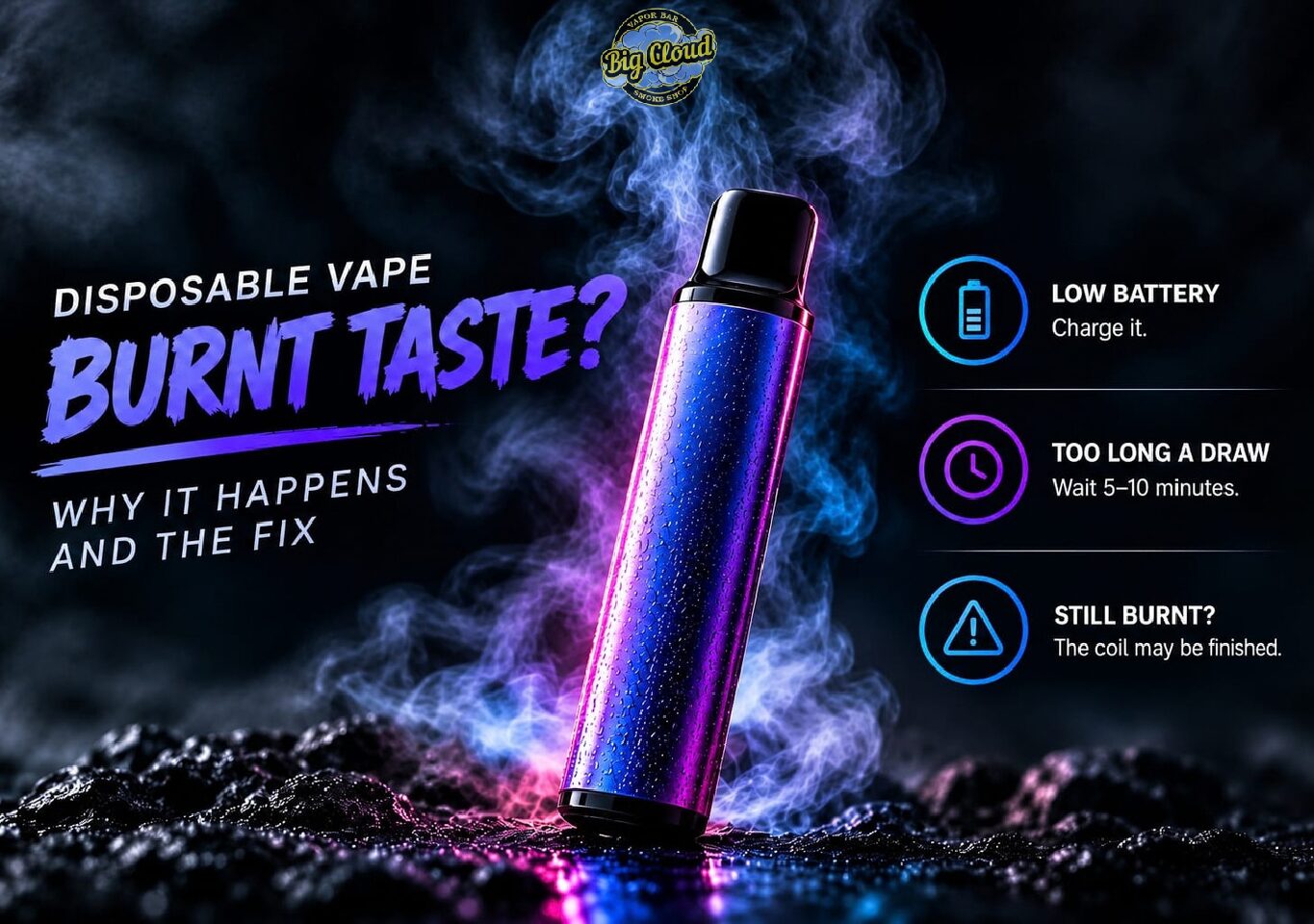
It tastes burnt. Usually chain vaping, which doesn’t give the wick time to re-saturate. Resting the device for five to ten minutes fixes it more often than not. See how to fix a burnt taste.
-
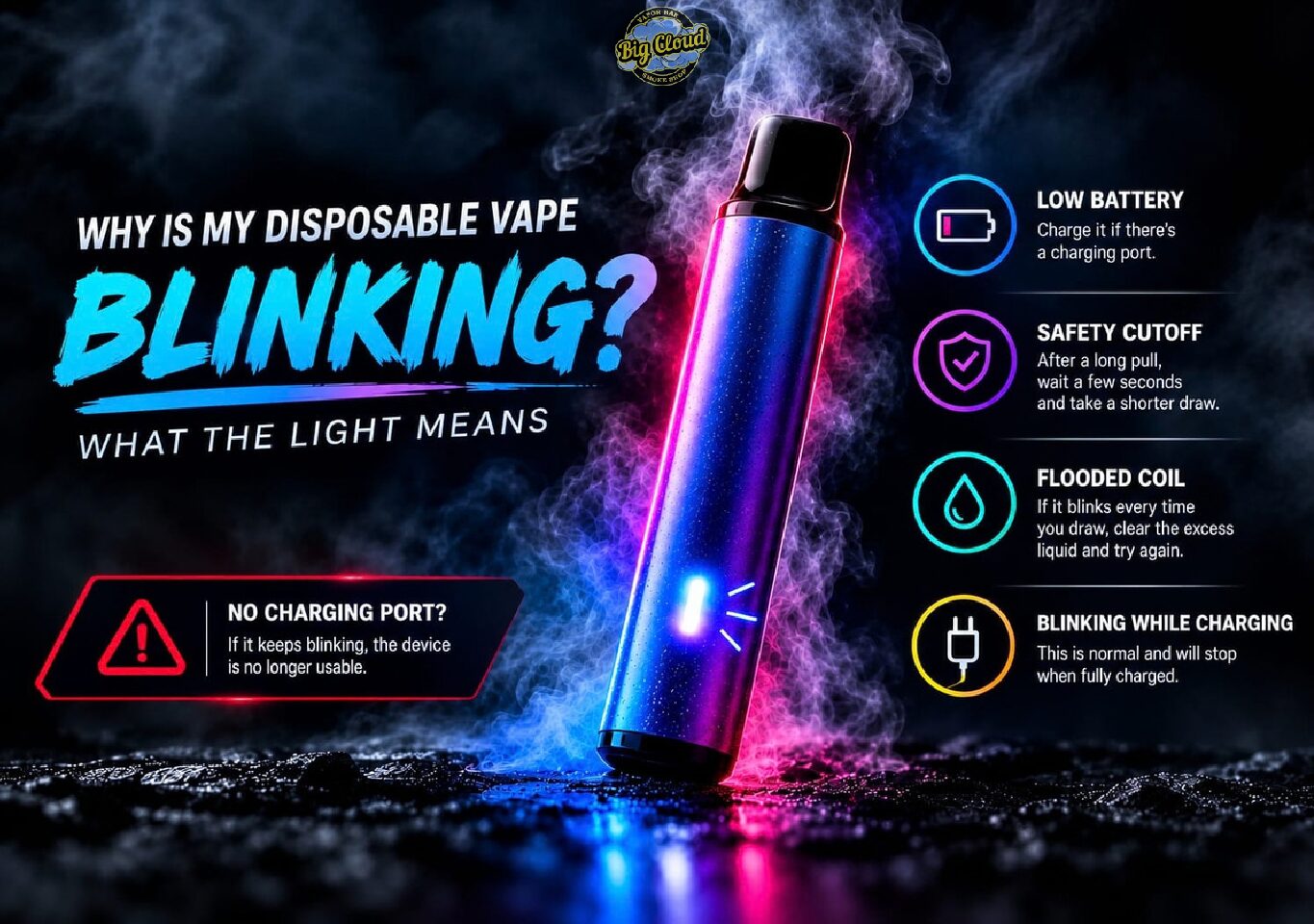
The light is blinking. Almost always a flat battery or a safety cutoff after a long draw, rarely an empty tank. See what a blinking light means.
-
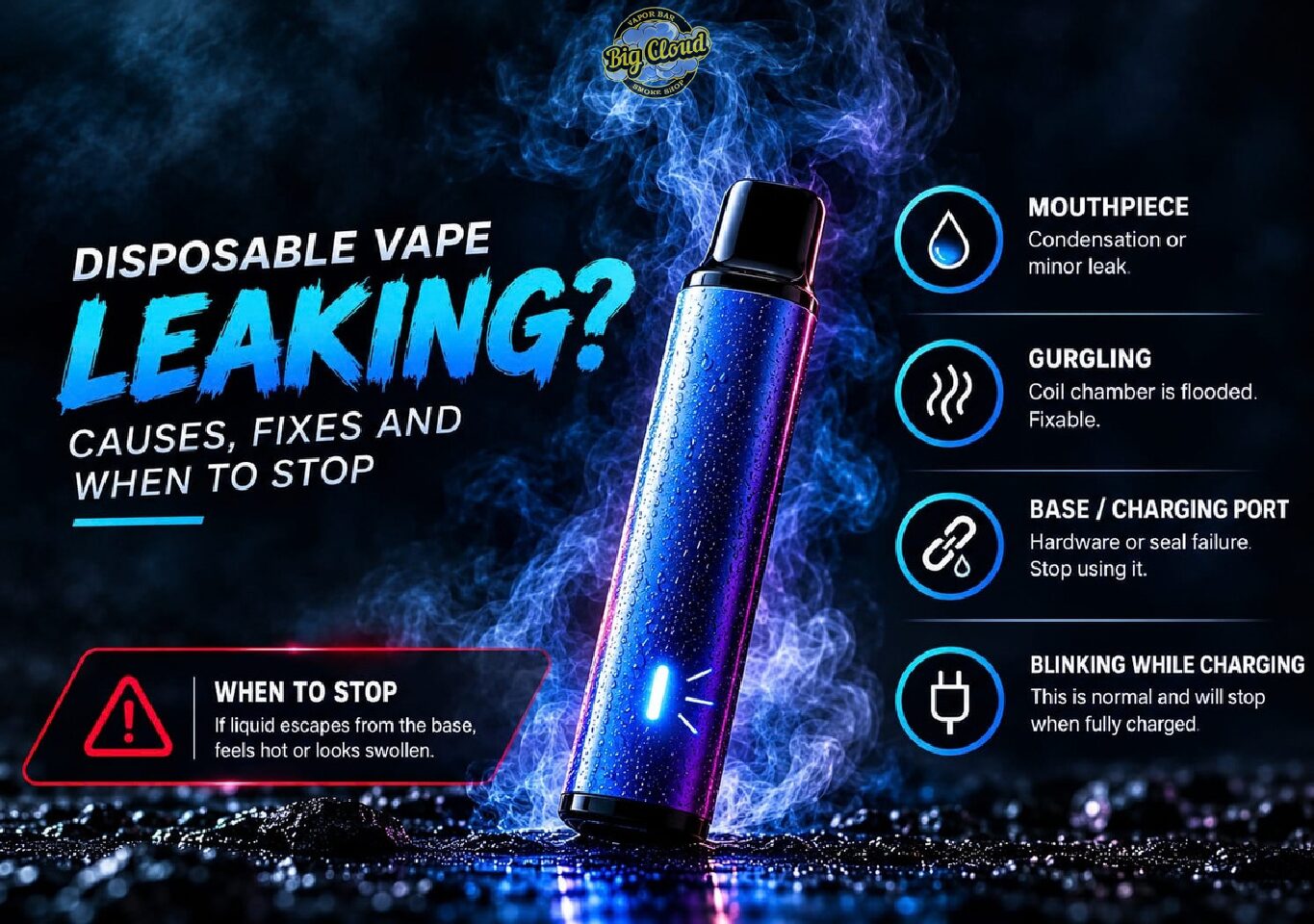
It’s leaking. Usually flooding from drawing too hard or storing it mouthpiece-down. See how to fix a leaking disposable.
-
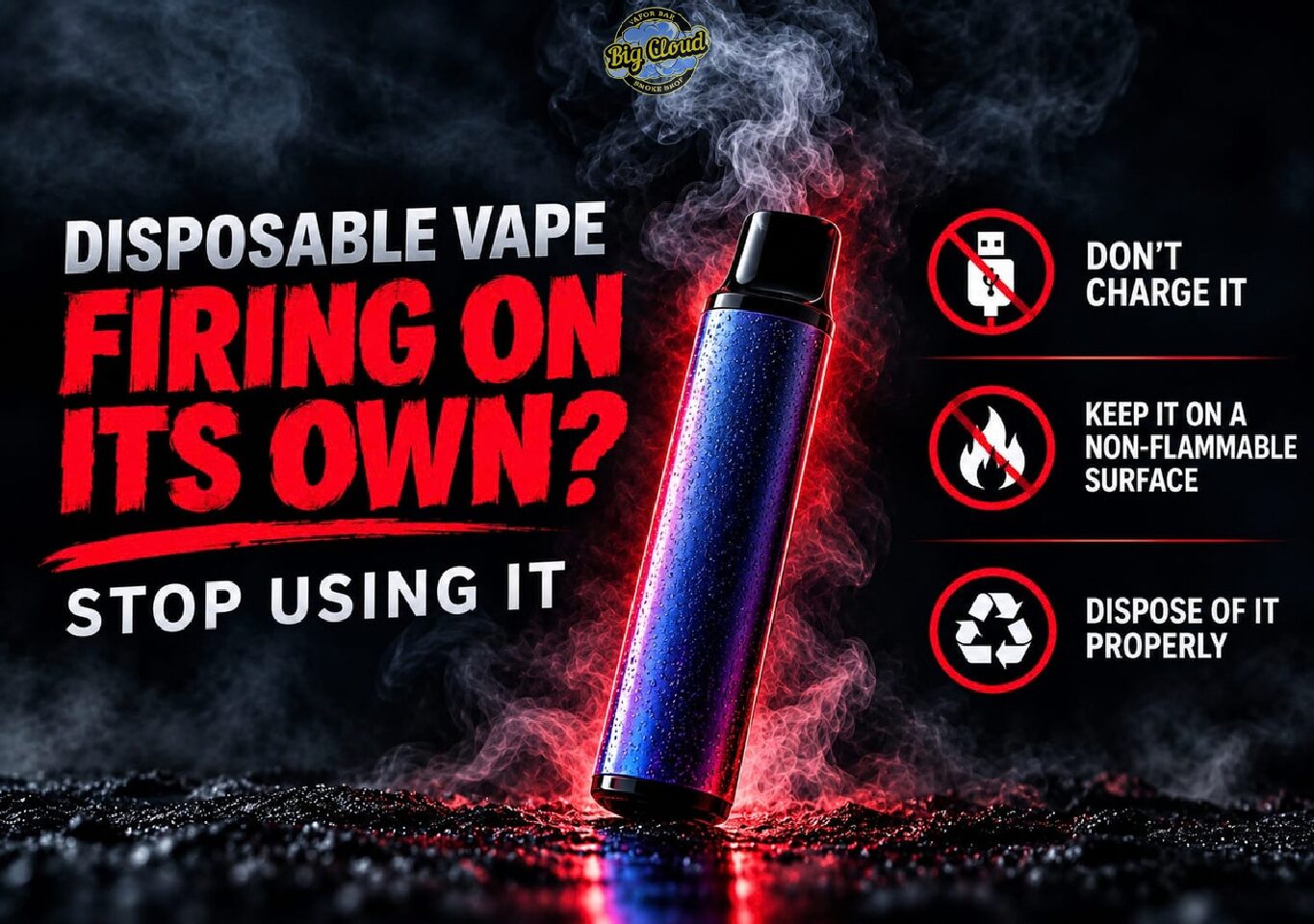
It’s firing on its own. This one is a safety issue, not a quirk: stop using the device, don’t charge it, and move it somewhere non-flammable. See what to do if a disposable fires by itself.
How to Choose a Disposable Vape
The main factor involved is essentially three questions: how often do you vape? Those who use it occasionally are generally advised to go for a small and low-commitment type of device, whereas people who use it every day can save money by choosing high-capacity rechargeables. Are you more concerned about the cost of the device or the cost per puff? Although small disposables are less expensive to buy, they can end up costing more than twenty times as much per puff as the most expensive devices. And which flavour category do you prefer? Fruit and fruit-ice mixtures account for the largest share of demand in Canada, then come mint and menthol, with tobacco flavours being aimed mainly at individuals who are quitting cigarettes.
Our beginner’s guide to choosing a disposable explains how to make your choice step by step, and the guide on flavour families looks at the six categories. So if you already have a general idea of what you’re looking for, choose one of these:
-
Best 50K-puff disposables in Canada, for the longest runtime and lowest cost per puff
-
Best 20K-puff disposables in Canada, the most popular middle ground
-
Best disposables under $30, if upfront price matters most
The Disposable Vape Brand Landscape in Canada
In the Canadian market a small number of brands hold control, each of them adopting a different strategy; these are the ones that we stock and have dealt with in full.
Elf Bar
It is one of the most well-known disposable vape brands on a global scale, offering a range in Canada that includes smaller models such as the BC5000 as well as the 20,000-puff GH20000; the brand is also one of the most counterfeited, making authentication important. Please refer to our Elf Bar Canada guide.
Vuse
Vuse, which is owned by BAT, offers for sale both the GO 1000 disposable device and a rechargeable pod system that comes with pre-filled flavour pods. The GO 800 and GO 5000 models have been discontinued in Canada. For more information, see our Vuse Canada guide.
Allo
The range offered by Allo is mainly composed of compact and inexpensive models, the majority of the devices providing fewer than 5,000 puffs and one flagship model offering 25,000 puffs. It is appropriate for people who use it occasionally or for those who are buying one for the first time. For more information, see our Allo Canada guide.
Flavour Beast
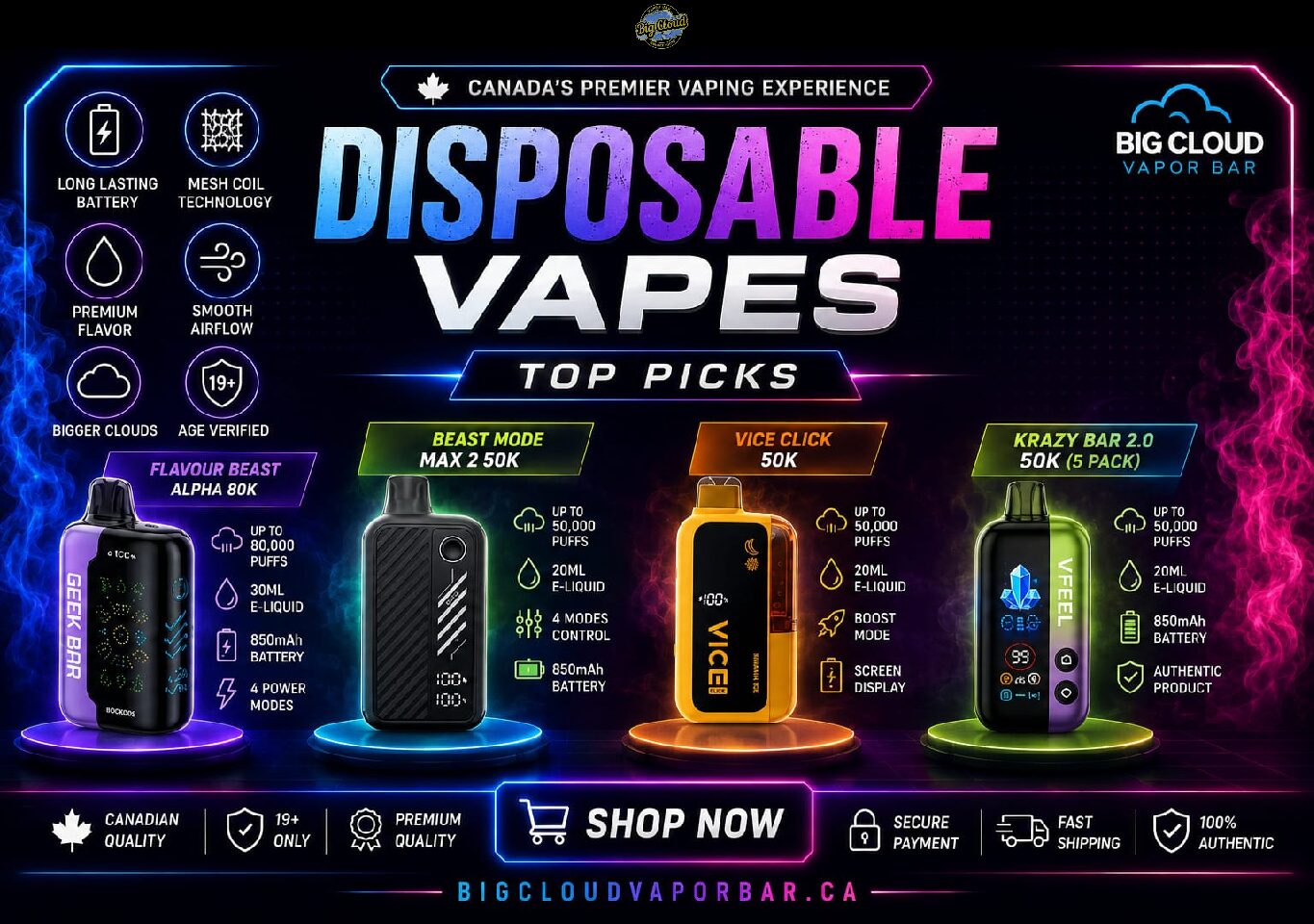
The brand from Canada is based on its variety of flavours and has the majority of its range in the high-capacity category. The Beast Mode Max 2 50K is one of the best value-per-puff devices available on the market. For more on the Flavour Beast review, and our Allo versus Flavour Beast comparison, see below.
Maskking
Maskking provides four models, starting with the simple Hybrid 2000 and ending with the Roki 15000, which features a side screen and dual firing modes. For more information, see our Maskking Canada guide.
Geek Bar
Pulse X 25K, a well-known international brand, is included in our range; refer to our Geek Bar Pulse X review.
Fog Formulas
The Fog Formulas Pro X 50K features a mixture of ‘Intense’ salt and freebase nicotine, giving it a more powerful throat hit at its 20 mg/mL limit, and has a stealth mode. For more on the Fog Formulas Pro X 50K, see our review of it.
Vice
The Vice Click 50K has a two-stage design consisting of a 2 mL preloaded dose and a 20 mL cartridge that you click into place when the first chamber is empty, hence the name. For more information, see our Vice Click 50K review or our Vice Click vs Fog Pro X comparison.
Krazy
The Krazy’s Bar 2.0 50K is in the high-capacity category together with the Vice and Fog Formulas. Please refer to our Krazy Bar 2.0 review.
RufPuf
The RufPuf Ripper Sleek 20K is one of the best-value 20,000-puff devices on the market, and a nicotine-free version is available in certain parts of the Canadian market. For more information, see the Ripper Sleek 20K.
Where to Buy Disposable Vapes
A Canadian retailer that is legitimate can be recognised on the basis of four criteria: there being an excise stamp on each device, the use of child-resistant packaging, proper age verification, and a verifiable physical address. The guide we have on where to buy disposable vapes online in Canada gives a detailed account of the warning signs of grey-market sellers.
Big Cloud Vapor Bar is located at 4927 Kingsway in Burnaby and functions as an age-restricted store that sells specialty vapes, operating under BC’s E-Substances Regulation—which is the type of licensing that allows the full range of flavours to be offered in the province. You can view our full selection of disposable vapes on our website or go tothe Burnaby store to purchase them there.
Purchasing directly eliminates most of the uncertainty at once since you can check the excise stamp and the packaging before making payment, age verification takes place in person, and if there’s any problem with the device you can return it and talk to the person who sold it to you instead of sending an email and having to wait. For people in Metro Vancouver, this is therefore the most straightforward way of buying with confidence.
FAQs
What is the difference between a disposable vape and a vape pen?
A disposable vape is sealed and pre-filled, and is recycled once the e-liquid runs out. A refillable vape pen or pod system lets you replace the e-liquid, pods, or coils, so you can reuse the device.
Can you refill a disposable vape?
No, because disposables are sealed and intended for single use, the coil becomes worn out together with the e-liquid; even if you managed to get the liquid in, you would then be using a coil that is spent.
How much nicotine is in a Canadian disposable vape?
No more than 20 mg/mL, the federal maximum. Many devices sit at exactly that level, often labelled “Intense.” Nicotine-free (0 mg) versions are also sold.
Do vapes that are disposable need charging?
Some of them do. Those with a USB-C port are rechargeable and it is possible for the battery to run out before the e-liquid does. Devices without such a port are designed in such a way that both the battery and the e-liquid run out at about the same time.
Are disposable vapes legal in BC?
Yes, disposable vapes are legal in British Columbia for people who are 19 years of age or older. However, in BC only age-restricted specialty vape retailers can sell the full range of flavours; general retailers such as convenience stores are allowed to sell only products that have tobacco flavours.
What should I do with a used disposable vape?
Do not throw it away with your normal household waste. Instead, take it to a battery or electronics recycling point, for example one operated by Call2Recycle, since the lithium-ion battery can catch fire if crushed.